
SEO Content Writing For Beginners-A Comprehensive Guide

After learning content writing, most writers move on to learn SEO content writing. Because it has become essential now. Whether it’s a website or a personal blog, SEO is necessary to get your content discovered. Well, learning SEO content writing is not very difficult. SEO content writing for beginners is all about learning the SEO basics and how to write seo optimized content to create content for both humans and search engines.
If you have learned simple content writing, then you might find it easy to learn SEO content writing. While the basics of content writing remain the same, for SEO, you have to learn some additional things to make your content rank on search engines. Well, no worries…lets see it together, this article covers the complete guide on SEO content writing for beginners.
SEO Content Writing For Beginners-Learn SEO Basics
To understand anything well, it’s important to first understand its basics; the same goes for SEO content writing for beginners. There are some basic things that you have to learn well if you want to become an SEO content writer. Here are some of the basics of SEO content writing.
1. Keywords
Keywords are words or phrases that users use while making a search on search engines. Keywords are the most important part that you will have to learn in SEO content writing for beginners. When you will understand what keywords are and why they are important to use, then you can write quality SEO content.
2. Keyword Research
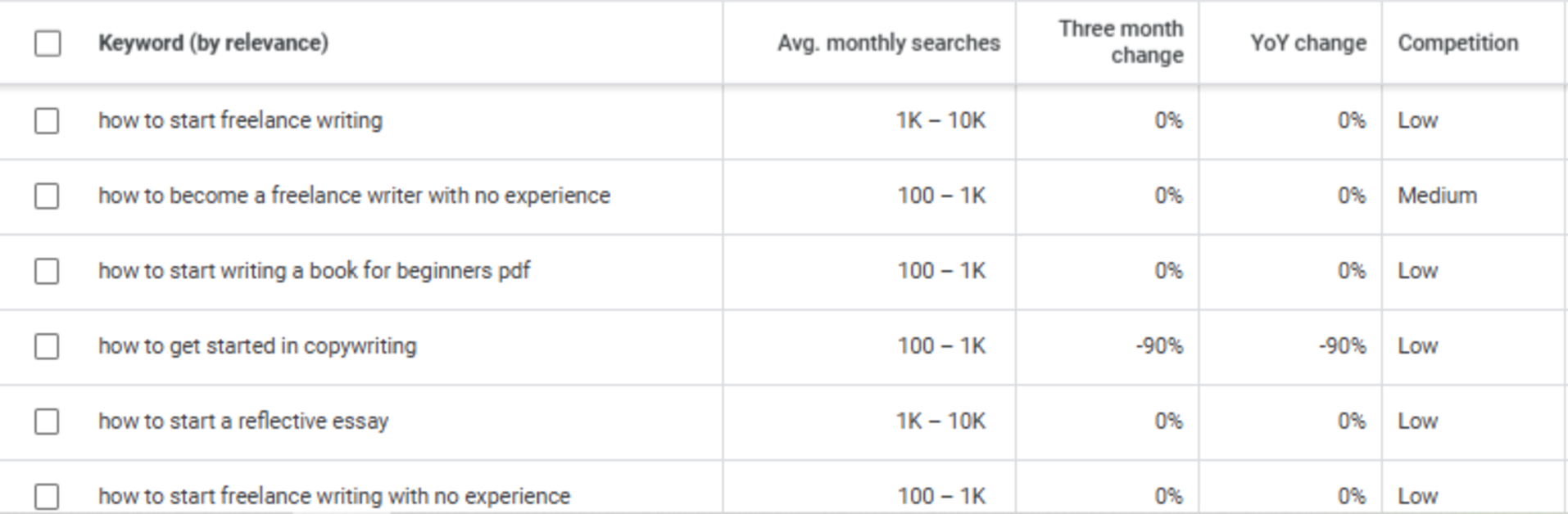
A big picture about keywords is doing keyword research. You have to do the keyword research to find out keywords that people are mostly using to make a search. When doing keyword research, the important things to consider are search volume, competition, and keyword difficulty.
- Search Volume means how many average searches are made for that particular keyword. E.g., 10K, 100K , 1M, etc
- Competition means how many advertisers or competitors are using or targeting that particular keyword. E.g., Low, Medium, High, etc.
- Keyword Difficulty means how difficult it is to rank on a particular keyword. A high number of keyword difficulity indicates that it will be difficult to rank on that keyword.
Remember as a beginner you should always select keywords with high search volume and low competition. As such, keywords increase your chances of ranking.
3. Primary & Secondary Keywords
There are two types of keywords in SEO content writing: Primary Keywords and Secondary Keywords.
Primary Keyword is the keyword for which a webpage is optimized. It is also known as the Main/Focus Keyword.
Secondary Keywords are those keywords that support and provide extra context to the Primary Keyword.
An article can have only the primary keyword, but secondary keywords can be more than one. Primary keywords often have more search volume than the secondary keywords, so that’s why they are used as main keywords. Keyword research will help you identify primary and secondary keywords.
Example: If your primary keyword is “Content writing for beginners”, then related primary keywords could be “Content writing tips for beginners”, “Beginner’s guide for content writing”.
4. Keyword Density
Keyword density means how many times a certain keyword has been used in your content. There is no specific percentage of a good keyword density, but generally, 1-2% is considered okay. But a high keyword density could be counted as keyword stuffing, and it is not good for SEO.
Example: If keyword count is 15 and total word count of article is 800, then keyword density is calculated as (15/800) *100 so keyword density =1.8.
5. Keyword Placement
Keywords Placement also plays a crucial role in SEO. Always use keywords and avoid keyword stuffing. One of the best practices to use keywords throughout your content is to use in:
- Title
- First 150 words of the article
- In one of the subheadings
- Naturally use in the content
- Conclusion
- Image Alt Text
- Meta Description
- Permalink
Remember a content without keywords is just simple content and not SEO content.
6. SEO Title
The next important thing to learn in SEO content writing for beginners is how to create an SEO optimized title for your content. The character length for an SEO title is between 50-60 characters.
You should keep the following things in mind while creating an SEO optimized title/Meta title:
- Primary keywords should be included in the title.
- It should be catchy enough to grab users’ attention.
- Ensure that it is relevant to the content.
- It’s good if you use numbers or power words to increase the CTR.
Example: If your blog title is “Tips for Blog Writing”, then you can make it optimized for SEO by using it like “10 Proven Tips for Blog Writing to Boost Traffic in 2025.”
7. Meta Description
Meta description is the summary of your content in a few words that appears under the title in search results. The character length for the meta description is up to 160 characters. Meta descriptions help readers to understand what is in the article, and it will be worth reading for them or not.
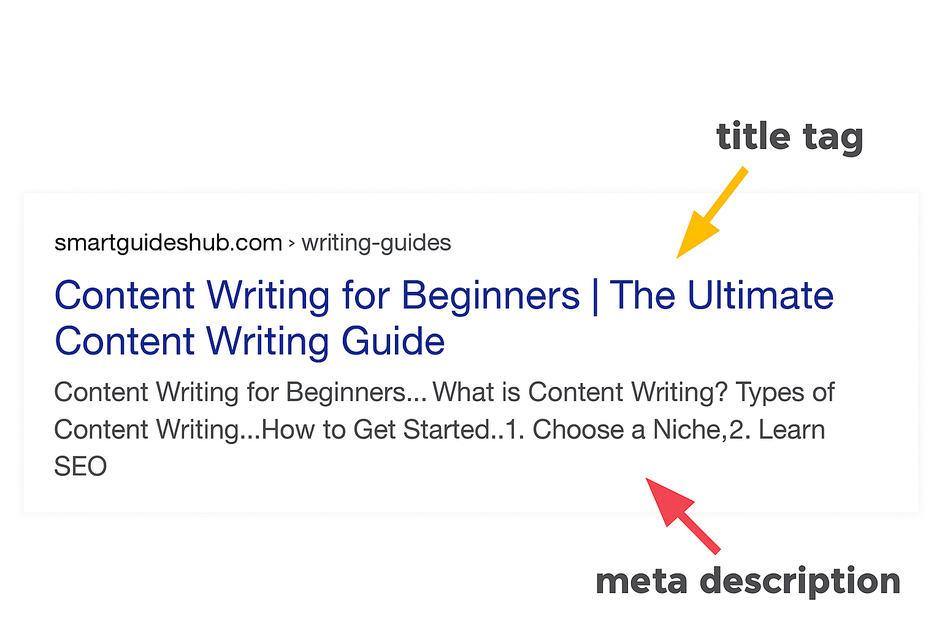
Here’s how to write SEO meta description:
- Include the focus keyword.
- Do not exceed the character limit.
- Should not be misleading, do not mention the things that are not in the content.
- Add the important points of the content precisely.
- Make it compelling enough to encourage readers to click.
Writing meta descriptions by following these points can effectively improve your CTR.
8. Links
In learning SEO content writing for beginners, understanding the links and their placement plays an important role. There are three main types of links in SEO.
- Internal Links: Internal links are links that direct users from one page of your website to another page. These links are used when you want the user to direct to another page of your website. Internal links improve site navigation and are used to increase engagement.
- External Links: External links are the links that link users to the pages on other websites. These links are used when you want a user to be directed to another website from your website. When you link users to other high quality websites, it signals to search engines that your content is well researched and increases your website’s credibility.
- Backlinks :Backlinks are the links from other websites to your website. When another website links to your website, it signals trust to search engines. It increases your website’s traffic,builds authority, improves visibility and ranking.
9. Images
SEO content writing is not just about text; images matter too. Images enhance the overall appearance of the content and increase the chances of engagement. There is no set rule for how many images to add to an article. Add as many as you think your articles need, but should be relevant to the topic. Choice of images plays a key role in improving the content readability.
Here’s how to choose an image for SEO content:
- Add high-quality and relevant images.
- It’s better if you add customized images rather than selecting one from stock photos.
- Avoid adding images with a large size and make sure that the format is webp, jpg, or png.
- Make sure all the images in an article are of the same size.
- Select images that would look good on different screens i.e, desktop, mobile, etc.
10. Alt Text
Alt text is a short text that is used to describe an image. It is an HTML attribute that is displayed when an image cannot be loaded. There is no defined character limit for Alt Text, but writing Alt Text under 125 characters is considered to be good. So from here you can get an idea that it should not be too short nor too long.
An important thing to keep in mind with respect to Alt Text is that at least one of your images’ Alt Text should contain the focus word.
11. SEO Content Structure
Structuring the content for SEO is a major part when learning SEO content writing for beginners. You have written SEO optimized content, but that alone is not enough until you have formatted it for SEO.
Here’s how to structure the content for SEO:
Headings/Sub-Headings Structure
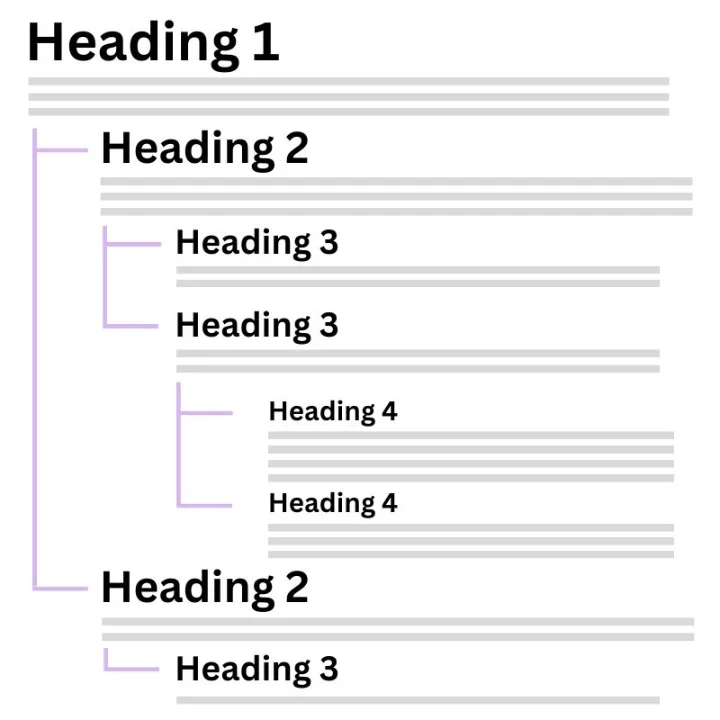
A proper format of headings should be followed, which is as follows:
- The title should be in the H1 heading.
- Then the first heading after the title or any other major headings in the content should be in H2.
- If the major headings (H2) content also had some headings then that should be included in H3.
- If there are more headings in your content after H3, then it should be included in H4, then H5 etc.
Text Structure
A proper text structure for SEO is as follows:
- Always break your content into short paragraphs to improve its readability. Generally, each paragraph with 3-4 sentences is considered good for SEO.
- Make your sentences short and make more use of the active voice.
- Use bullet points, numbering, or tables to add important information.
- Write in a natural tone that shows that your entire content is well linked.
Along with the structure make sure you have used rich keywords, images, internal/exetrnal links for SEO.
How to Write SEO Friendly Content
Now that you have learned the basics of SEO, you can write SEO content. Understanding how to write SEO friendly content is one of the major steps in content writing for beginners.
Let’s see how to write SEO optimized content:
1. Define the Audience and Search Intent
The first thing is to identify your target audience for whom you will be writing the content. The target audience is decided on a number of factors like location, age group, gender, interest, etc. Once you have identified your target audience, the next thing is to define the search intent to align with users’ searches. It can improve your website ranking and bring more traffic and engagement.
2. Do Keyword and Topic Research
The second step is to do the keyword research. Make a list of keywords you have researched and mark the primary and secondary keywords from those. Also, select the title in this step. There are different tools available for keyword research: Google Keyword Planner, Semrush, Ahrefs, Moz, and many more. You can select the one that you find easy to use.
When you have completed keyword research, then do thorough research on the topic to write quality SEO content. Topic research is necessary to get the information on the topic, in this way you will also get an idea of how to write on that topic.
3. Plan and Prepare a Rough Draft
When you complete your research, then plan how you will write the content, what the structure will be, what information you will add, how many keywords you will be using etc. Prepare a rough draft of your content; in this way, you will be able to write with more clarity.
4. Start Writing
Now start writing by following the rough draft. While writing SEO friendly content, keep the following points in mind:
- Write in a clear, organized way and in simple words.
- Your content should be engaging and helpful for readers.
- Focus more on quality than quantity (word count).
- Make sure that you have covered the topic descriptively.
- Follow the SEO practices (content structure, images, keywords placement, etc.)
After you have completed writing, do cross cross-check with the rough draft to make sure that you have not missed any point.
5. Do On-Page SEO
When you have written the content, do the On-Page SEO. By doing On-Page SEO, it means that you have optimized your content for SEO:
The following things are involved in doing On-Page SEO of the content:
- Use keywords naturally.
- Do the right keyword placement.
- Follow the correct heading (H1,H2, H3 etc) and content structure (short paragraphs) .
- Write the meta description and meta title.
- Add the images with Alt Text.
- Add internal and external links.
- Optimize the images for size, format, and fast loading.
- Make sure that the links added are fully working.
- Add FAQ schema.
6. Proofread and Edit
Always proofread your content. Use different writing tools to check for grammatical errors. Check it for clarity and flow. The best way to check your content is by reading it from the perspective of the reader rather than the writer.
7. Update the Content When Needed
Your work doesn’t end by completing the writing; you have to update the content as well. Over time, keywords might change; the ones you used previously have no search volume now, and new keywords are being searched in place of those. So you have updated the content and keywords whenever needed to keep going in the race.
Common Mistakes to Avoid as a Beginner SEO Content Writer

One of the biggest challenges in SEO content writing for beginners is to avoid the mistakes that can affect your content. Let’s have a look at what those mistakes are:
- Avoid doing keyword stuffing. Always use keywords naturally throughout the content.
- Ignoring the keyword placement. Using keywords, but not in the right places.
- Ignoring the keyword density.
- Neglecting the search intent.
- Targeting more short tail keywords instead of long tail keywords.
- Writing the content that is plagiarized.
- Neglecting the SEO content/heading structure.
- Using jargon words instead of simple words.
- Using long sentences and paragraphs instead of short ones.
- Using broken links.
- Focusing more on word count and neglecting the content quality.
- Ignoring the SEO title, meta description, and permalink character length.
- Overlooking the image dimensions and formats, and using images that take more time to load.
- Not using catchy headings or CTA’s.
- Not adding FAQ’s relevant to the topic that can increase the chances of getting ranked in the AI overview.
SEO content writing for beginners can first seem overwhelming and challenging. You might feel like you have to learn a lot for it. But believe me, when you learn it properly, you will enjoy doing it. By focusing more on learning SEO basics and how to write SEO friendly content, you can write content that not only ranks but also adds value for readers. You just need to be consistent, and with the passage of time, you will master it.
After reading this guide on SEO content writing for beginners, what are you waiting for now…just start your journey as a SEO content writer and inspire others through your words!
FAQ
How to write a good meta description?
To write a good meta description summarize the content in simple words. Include your focus keyword and make it engaging that encourages the user to click. Most importantly do not exceed the meta description character limit i.e, up to 160 characters.
How to become a freelance SEO writer?
To become a freelance SEO writer, learn SEO basics, improve your writing skills and build a portfolio. Find clients on platforms like Fiverr, Upwork etc. Offer your services to clients at a low rate in the starting and then gradually increase your rates once you become an experienced freelance SEO writer.
Which is the best AI writer for SEO?
Surfer AI, Frase AI, Writesonic and Jasper AI are some of the best AI writers for SEO.