
How to Optimize Content For SEO

Nowadays, creating great content is not enough; you also need to optimize it for SEO to rank on SERPs, and that’s where learning how to optimize content for SEO becomes a game-changer. If you put all your effort into writing high-quality content but fail to optimize it for SEO, then your efforts will be in vain. That’s why, along with creating the content, it is also important to learn to optimize it for SEO.
Optimizing content for SEO helps your website to rank in the top results on SERP. It drives the user to click and read the content on your site. If your content is well optimized for SEO, it will rank even long after you have published it. Search engines favours and ranks only that content that is well optimized for SEO. So to stand out on SERP, you have to optimize your content for SEO.
But many people do not really know how to optimize content for SEO actually. If you are also one of those people, then you are at the right place.
In this guide, we uncover some of the useful tips on how to optimize content for SEO.
How to Optimize Content For SEO - Tip #1: Match the Search Intent
Search intent is the reason behind users’ queries on search engines. It tells you what users are searching for. It is important to match the search internet to ensure that your content actually matches what users are looking for.
There are four types of search intent:
- Informational Search Intent
- Transactional Search Intent
- Navigational Search Intent
- Commercial Search Intent
Each type tells us why the user is making a search query i.e, to learn, buy or navigate, etc.
Search engines prioritize relevance, and search intents are a great way to align with the relevance. Your content only gets ranked on search engines when it is relevant and matches the user’s search query. Before writing the content, first identify the search intent by analyzing the keywords to increase the chances of ranking on top results.
So matching the search intent is important to optimize content for SEO and get the desired ranking.
How to Optimize Content For SEO - Tip #2: Use Primary and Secondary Keywords
Keywords play an important role when it comes to content optimization. In fact, keywords are considered a building block for SEO content optimization.
There are two types of keywords in SEO: Primary Keywords and Secondary Keywords.
Primary Keyword is the keyword for which a webpage is optimized. It is also known as the Main/Focus Keyword.
Secondary Keywords are those keywords that support and provide extra context to the Primary Keyword.
An article can have only the primary keyword, but secondary keywords can be more than one. Primary keywords often have more search volume than the secondary keywords, so that’s why they are used as main keywords. Keyword research will help you identify primary and secondary keywords.
Example
If your primary keyword is “Content writing for beginners”, then related primary keywords could be “Content writing tips for beginners”, “Beginner’s guide for content writing”.
How to Optimize Content For SEO - Tip #3: Write Comprehensive Content
Writing comprehensive content is one important thing to optimize for SEO. Search engines like Google always prefer in-depth and detailed content as they aim to provide full information to the users. When making any search, most users are also looking for detailed information rather than short ones.
When you write comprehensive content, you answer all users’ all queries and go beyond what’s already there, and that’s a great way to increase the engagement rate of your website. Researches have shown that longer content ranks well on Google as it provides more information on the topic users are searching for. It also gives you a chance to rank on different search queries.
But remember one thing; do not compromise on the quality of the content when focusing on quantity. Along with content length, search engines also look for the quality of the content. So you don’t have to just fill the space, but write high quality and engaging content by keeping in mind the SEO principles.
Along with this, always ensure the accuracy of the content you are writing. Adding up-to-date information builds trust with users and search engines. While writing the comprehensive content, also focus on writing the content in simple words and with proper formatting that is easier for users to understand.
How to Optimize Content For SEO - Tip #4: Structure your Content
A properly structured content is good for SEO. It improves the content readability and makes it easier to understand.
Here’s how to structure the content for SEO:
Headings/Sub-Headings Structure
A proper format of headings should be followed, which is as follows:
- The title should be in the H1 heading.
- Then the first heading after the title or any other major headings in the content should be in H2.
- If the major headings (H2) content also had some headings, then that should be included in H3.
- If there are more headings in your content after H3, then it should be included in H4, then H5 etc.
Text Structure
A proper text structure for SEO is as follows:
- Always break your content into short paragraphs to improve its readability. Generally, each paragraph with 3-4 sentences is considered good for SEO.
- Make your sentences short and make more use of the active voice.
- Use bullet points, numbering, or tables to add important information.
- Write in a natural tone that shows that your entire content is well-linked.
How to Optimize Content For SEO - Tip #5: Do the On-Page SEO
On-page SEO is very important to optimize the content for SEO. It increases the chances for content to rank on SERP results.
Do the on-page SEO by keeping in mind the following points:
- Make the title SEO optimized by using the primary keyword and keep it up to 60 characters only.
- Strategically do the keywords placement that is best for SEO. You must use your primary keyword in the first 150 words of the content, at least on one of the subheadings, throughout the content (but naturally, do not stuff the keywords) and in the concluding paragraph.
- Keep the keyword density between 1-2%.
- Structure your content in proper headings and subheadings.
- Use short paragraphs with a maximum of 3-4 lines each paragraph.
- Use a more active voice to make the sentences precise.
- Add relevant internal and external links.
- Use the primary keyword in the permalink.
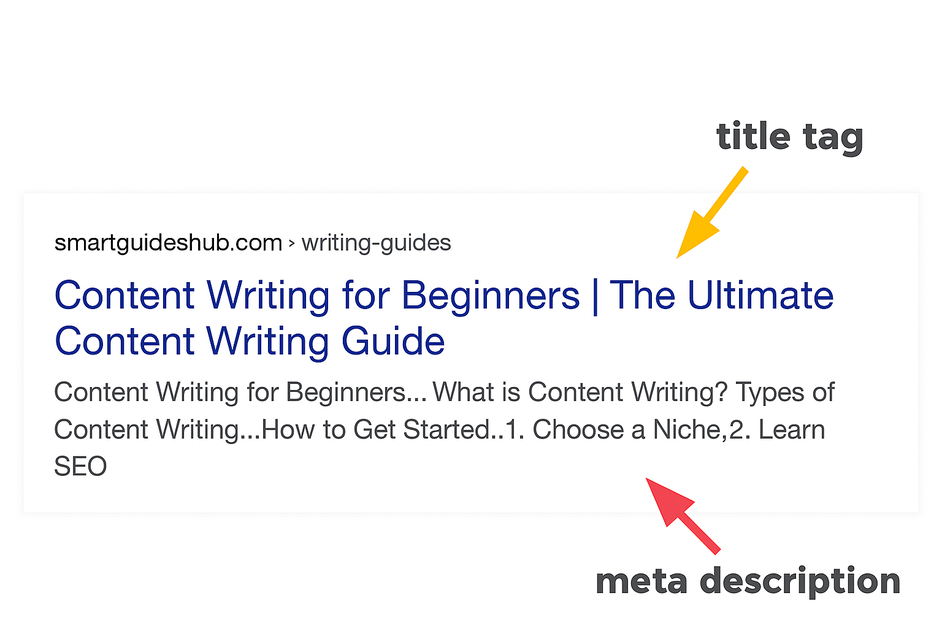
- Write a meta description that is up to 160 characters maximum and has the primary keyword.
- Create engaging meta titles that drive users to click.
- Use alt text for all the images (under 125 characters is considered to be good). Use the primary keyword as alt text for at least one of the images.
How to Optimize Content For SEO - Tip #6: Optimize the Visual Content
A big part of optimizing content for SEO is to optimize that visual content, which can improve both user experience and SERP ranking.
To optimize the visual content, you should:
- Compress the image before using it without losing its quality to ensure fast-loading pages.
- Use descriptive file names and keyword-rich alt text.
- Use captions for every image and a transcript for every video.
- Use visuals that align with the content and complement it.
- Use fast loading image formats like SVG, WebP, JPG, PNG, etc.
- Resize/compress the image to smaller dimensions to reduce the loading times. Try to keep the width of the image under 2500 pixels.
- Use responsive image scaling to ensure the best user experience for different kinds of devices.
- Create image sitemaps to ensure that search engines always crawl and index your visual content.
How to Optimize Content For SEO - Tip #7: Improve User Experience
Search engines favours websites that keep visitors happy and engaged, and for that you have to focus on improving the user experience. You can improve the user experience of your website by optimizing your website for technical SEO.
To optimize your content for SEO to improve the user experience, you should ensure that your website has :
- Resolve any Core Web Vitals issues.
- Fast loading pages to deliver a quick user experience.
- All the content, images and other media loads quickly.
- Your website is mobile-friendly.
- A clean layout that easily adjusts to the different screen sizes.
- Connection security, i.e, TLS/SSL certificate.
- All the pages are included in the site’s XML sitemap.
- Schema markup to enhance search visibility.
- Avoid using intrusive ads or pop ups that disrupt user experience.
How to Optimize Content For SEO - Tip #8: Add E-E-A-T Signals
Adding E-E-A-T signals is crucial to optimize your content for SEO. Search engines prioritize the content that demonstrates E-E-A-T signals.
You can add the E-E-A-T signals by:
Demonstrating Experience: You can demonstrate experience by adding the author’s bio, which tells how many years of experience the author has working in this field. Another great way to demonstrate your experience is to add the link to your LinkedIn profile.
Demonstrating Expertise: You can display your experience by mentioning your areas of expertise in the bio. Another great way to demonstrate your experience is to write in-depth content that highlights your knowledge about the topic.
Demonstrating Authoritativeness: You can build authoritativeness by creating relevant content on the topic. Include backlinks from well-reputed websites that show you have researched your content from reliable sources.
Demonstrating Trustworthiness: You can build trustworthiness by regularly updating your content to show that you stay updated about the latest information on the topic. It shows that your content is accurate and backed by reliable sources.
How to Optimize Content For SEO - Tip #9: Optimize for Featured Snippets
Optimizing for featured snippets is a great way to optimize your content for SEO. Featured snippets, AI Overviews, and People Also Ask are some of the common examples of SERP Features. Optimizing for any of these features increases the visibility of your content.
To optimize your content for featured snippets, you should:
- Write content in a conversational tone.
- Write precise and clear answers to question-based queries typically within 40-60 words.
- Create well structured content by using proper headings/subheadings, numbered lists, bullet points etc.
- Address the user queries directly. For this address, long tail keywords and question based queries.
- Add quotes and citations for credibility, as search engines feature only that content which is from reliable sources.
- Incorporate a FAQ section in your content.
For more detail read: Geo Optimization for Writers: How to Write Geo-Friendly Content
How to Optimize Content For SEO - Tip #10: Keep Updating the Content
Your work doesn’t end by optimizing the content; you have to update the content as well. Over time, keywords might change; the ones you used previously have no search volume now, and new keywords are being searched in place of those. So you have updated the content and keywords whenever needed to keep going in the race.
Updating the content helps to maintain relevance with current search terms and improve ranking over time. Adding new information to the articles keeps them accurate and updated for readers. When updating the content, also check for external links to ensure that none of the links are broken and they are working properly.

Optimizing the content for SEO is all about understanding and adapting the above 10 tips. Be it matching the search intent, using the right keywords, optimizing for visual content or adding E-E-A-T signals all are steps towards improving the overall SEO of your content.
Remember one thing, along with adapting these tips, also monitor your results regularly to figure out the areas of improvement. It’s not just a one time thing; you have to keep checking and updating the content and adapt new SEO practices to make your content stand out in SERP. Be consistent with your SEO and you will see the results yourself.
Now that you have this easy guide on how to optimize content for SEO, start following this guide to make your content ranked on top in search results.
Read Also: SEO Content Writing For Beginners-A Comprehensive Guide
FAQ
What is the 80/20 rule in SEO?
The 80/20 rule in SEO means that around 80% of your traffic and results come from 20% of your content or keywords. It focuses on identifying and optimizing high-performing pages to maximize SEO impact with less effort.
How do you know your content is optimized for SEO?
You know your content is optimized for SEO by following on-page SEO best practices which includes targeting the right keywords, meeting the user intent, proper headings, meta tags, internal links and readable formatting. Regular performance tracking in tools like Search Console confirms ongoing optimization.
Can ChatGPT do SEO?
Yes, ChatGPT can help with SEO by generating keyword ideas, writing optimized content, improving on-page SEO, creating meta titles and descriptions, and suggesting content structure. However, human review and strategy are still essential for best results.