
How to do Keyword Research For Google Ads
Keywords research serves as a foundation for successful Google Ads campaigns. It is the most essential and, in fact, the most tricky part of Google Ads. But many people do not know how to handle this tricky part. And when their campaigns are not giving them the desired results, they start looking for ways on how to do keyword research for Google Ads. Doing keyword research for Google Ads is not as difficult as it is thought of. You just need to follow the right steps and adapt the correct strategy to do the keyword research.
Keyword research matters in Google Ads because it directly affects your conversion rate, CTR, and ROI. That’s why it is the most important part on which you have to work on for running Google Ads. It requires a strategic approach to balance cost and performance.
If you are new to Google Ads or running Google Ads but are not getting your desired results, then this guide is for you.
In this guide, we will see a step-by-step guide on how to do keyword research for Google Ads and some of the tips that can help you while doing keyword research.
How to do Keyword Research For Google Ads: A Step-by-Step Guide
Doing keyword research for Google Ads is all about discovering the exact search terms that users are using while making any search on the SERP and analyzing the associated metrics with it.
Let’s have a look at the steps on how to do keyword research for Google Ads:
Step 1: Choose The Type of Campaign
The first step in how to do keyword research for Google Ads is to select the type of campaign you want to run. There are different types of Google Ads campaigns, each of which has its own set of goals and objectives.
- Search Campaigns
- Display Campaigns
- Video Campaigns
- Demand Gen Campaigns
- Performance Max Campaigns
- App Install Campaigns
- Smart Campaigns
- Local Campaigns
- Discovery Campaigns
- Shopping Campaigns
Step 2: Define Your Campaign Goals
The second step in how to do keyword research for Google Ads is to define the goals of your campaign i.e, what you want to achieve through the campaign. Your campaign goal will identify the type of keywords that you should use.
For Example
If your goal is to increase website traffic, than you should target “ broader informational keywords”, if your goal is sales that target high intent keywords like “buy now, order now, place order now, limited time offer”, if your goal is to generate leads than target keywords that reflects query or inquiry like “book a consultation now, get a quote” etc.
Step 3: Identify Your Target Audience
The third step is to identify your target audience and their search intent. It is important to identify the target audience to choose the right keywords. In this step, you have to identify your ideal customer and narrow them down by location, gender, interest , online behaviour, and search intent. Matching the user’s search intent is important to create more relevant ads and attract potential users.
Step 4: Select Keyword Research Tool
The fourth step in how to do keyword research for Google Ads is to choose the tool that you will use for doing keyword research. There are different keyword tools available for different types of campaigns. You can use one or many to find and target different keywords.
Google Keyword Planner is a free and widely used tool for doing keyword research for different types of campaigns.
If you are doing keyword research to drive traffic on your site, then Ubersuggest, SEMrush, and Ahrefs are good tools that you can try out. If you are doing keyword research for App Install campaigns, then you can use AppAnnie, AppTweak, AppGrowing, etc.
Google Ads transparency is another good tool that you can use to find competitors’ keywords that are running ads on Google and other partner networks.
Step 5: Find Your Targeted Keywords
Once you have selected your keyword tool, start with the keyword research process. Make a list of all selected keywords.
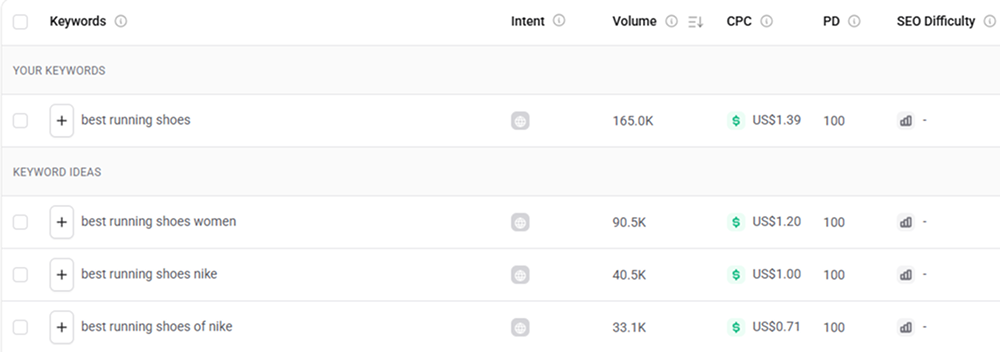
The metrics to analyze when doing keyword research depend on the type of your campaign. Generally, the following metrics are analyzed when doing keyword research:
- Search Volume (to know how many users are making searches using a particular keyword).
- Competition ( to know how many competitors are targeting a particular keyword).
- Intent ( to know the type of user’s search intent).
- CPC (cost per click, it is the average cost that you have to pay to Google to display your ads on different networks. A high CPC indicates that the keyword is more valuable. )
- SEO Difficulty ( to determine how difficult it is for you to rank on a keyword. A high keyword difficulty indicates higher competition, which means it will be difficult to rank on such a keyword).
This was a complete step-by-step guide for doing keyword research for Google Ads. Once you have selected the keywords and made a list now group the keywords by theme to create ad groups for your campaign.
The keyword research process does not end with doing keyword research one time. It’s an ongoing process, over time keywords may change, their volume and competition also. So in that case, you have to update your ad groups. When the campaign goes live, continuously monitor the performance of the keywords, conversion rate, and CTR to identify and best and under performing keywords. Replace the underperforming keywords with new ones to improve your ROI and ensure effective results of your Google Ads campaigns.
Google Ads Keyword Research Tips
Along with learning how to do keyword research for Google Ads, here are some of the tips that can help you in your keyword research process.
- Always select high search volume and low competition keywords.
- Focus on the intent of the keywords and then select.
- Target long tail keywords.
- Avoid selecting irrelevant keywords.
- Check the competitors’ keywords using different keyword research tools.
- Do keyword research by selecting different locations.
- Use localized keywords to expand your campaign’s reach.
- Avoid using branded keywords or the one with trademark issues to prevent keyword disapproval issues by Google Ads.
- See how keywords have trended over time by analyzing the YoY change metric.
- When selecting keywords, keep in mind the match type, negative keywords, and CPC.
Tools to Use for Google Ads Keyword Research
Here are some of the helpful tools that can help you in your research for Google Ads:
- Google Keyword Planner
- SEMrush
- Moz
- Ubbersuggest
- Ahrefs
- Google Ads Transparency
- Google Trends
- AnswerThePublic
- Sensor Tower
- Fox Data
- AppAnnie
- AppTweak
- AppGrowing
By learning how to do keyword research for Google Ads you can create highly targeted ads and reach the right users at the right time. Focusing on each step like defining campaign goals, finding user search intent, and analyzing key metrics, you can attract your target audience and get your desired results. Remember one thing that keywords do not show their results immediately, so you have to wait for that, test different keywords, see their performance, and then make a decision.
So what are you waiting for, now that you have this easy guide on how to do keyword research for Google Ads, start your keyword research process now and get the best return on your ad spend.
Read Also: SEO Content Writing For Beginners-A Comprehensive Guide